Joomla Facts: 20 Verified Facts and Numbers, Measured From the Source
Verified Joomla facts with numbers measured from the official 3.10.12 and 6.1.2 packages: fork dates, Swahili codenames, files, tables, extensions, database drivers, languages, security and 2026 market share, plus the popular claims that do not check out.

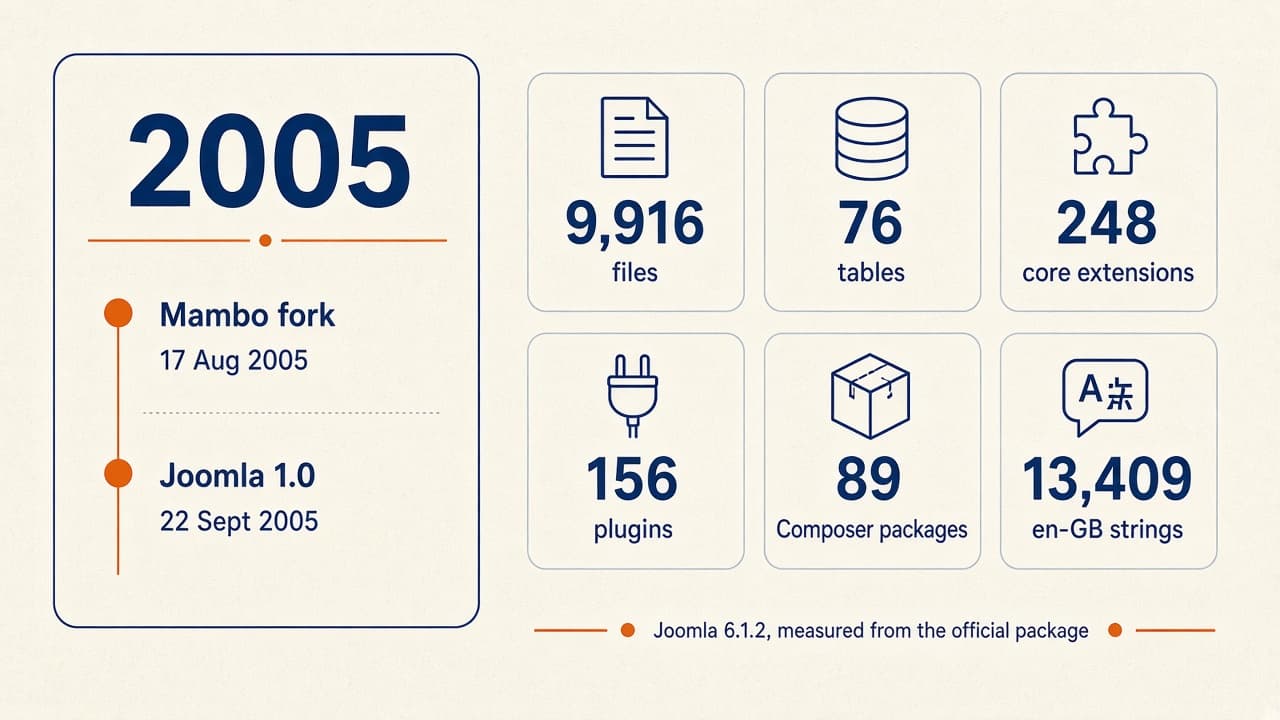
Joomla is a free, open source content management system that started on 17 August 2005 when the core developers of Mambo left that project and forked its code. The name comes from the Swahili word jumla, meaning "all together" or "as a whole". It is owned by a non-profit, Open Source Matters, Inc., built by volunteers, and as of Joomla 6.1.2 it ships as 9,916 files, 76 database tables, 248 core extensions, 89 Composer packages, and 13,409 English language strings. Those last five numbers were counted from the official release package, not copied from another article.
Most "Joomla facts" posts repeat the same ten lines: born from a rebellion, Swahili name, volunteers, big brands use it, good security record. Several of those lines are wrong or unverifiable. This article keeps the facts that check out, corrects the ones that do not, and adds a set of numbers nobody else has published: what is actually inside the Joomla 3.10.12 and Joomla 6.1.2 release archives, measured file by file. Where a fact comes from Joomla's own code or a primary source, the source is linked.
What you will learn
- The real dates behind the Mambo fork, the name, and the first release
- What the Swahili codenames mean and where the copyright line points
- Joomla 3.10.12 versus Joomla 6.1.2 by the numbers: files, PHP lines, tables, extensions, strings, packages
- Which database drivers Joomla really ships, and why "Joomla supports MS SQL" needs a date
- How many languages come "out of the box" (the 70+ claim is wrong)
- What the security statistics do and do not say
- Where Joomla stands in 2026 market share, and why half of the Joomla web is still on version 3
How these facts were checked
Historical facts are linked to Joomla's own announcements, Open Source Matters, or the Joomla issue tracker. Technical facts were measured on 24 September 2026 by unpacking the official Joomla_6.1.2-Stable-Full_Package.zip and Joomla_3.10.12-Stable-Full_Package.zip from the joomla-cms GitHub releases and running a small Node script over the folders. "Core PHP" means every .php file outside libraries/vendor and media/vendor. "Vendor" means those two folders. Market share figures are from W3Techs, August 2026. Nothing below is an estimate unless it says so.
Facts 1 to 6: origin and name
1. Joomla began as a walkout, and the fork happened on 17 August 2005
Joomla did not start from a blank editor. The core developers of the Mambo CMS published an open letter on 17 August 2005 announcing they were leaving because of a dispute over the governance of the Mambo Foundation set up by Miro International. They forked the Mambo 4.5.2.3 code and formed a non-profit, Open Source Matters, Inc., to hold the project's assets. More than a thousand people registered on the new opensourcematters.org site within a day. The letter and the timeline are still archived on joomla.org.
2. The name was announced two weeks later, and the first release was a renamed Mambo
The project had no name for two weeks. "Joomla!" (with the exclamation mark, which is part of the official name) was announced on 1 September 2005. Joomla 1.0.0 followed on 22 September 2005. That first release was Mambo 4.5.2.3 with the branding changed and a handful of bug fixes, which is why every early Joomla tutorial still worked on Mambo and vice versa. Real divergence began with Joomla 1.5 in January 2008, which introduced the framework layer and the first API break.
3. "Joomla" is Swahili, and so are the release codenames
Joomla is an English spelling of the Swahili word jumla, "all together" or "as a whole". The convention did not stop with the product name. Every release carries a Swahili codename in libraries/src/Version.php: Joomla 3.10.12 is Daraja (bridge, because 3.10 was the bridge to Joomla 4), Joomla 5.4 is Kutegemea (to rely on), Joomla 6.0 is Kuimarisha (to strengthen), and Joomla 6.1 is Nyota (star). The codename is a real constant in the code, so you can read it from your own install:
// libraries/src/Version.php in Joomla 6.1.2
const MAJOR_VERSION = 6;
const MINOR_VERSION = 1;
const PATCH_VERSION = 2;
const DEV_STATUS = 'Stable';
const CODENAME = 'Nyota';
const RELDATE = '7-July-2026';
4. The logo was chosen by community vote; the name was not
A popular version of the story says the name Joomla was picked by a public poll. The core team chose the name and announced it. What the community did vote on was the logo: a design competition ran in September 2005 and the winning entry, the four interlocking figures, became the mark that is still in use. If you want a "democratic from day one" fact, the logo is the accurate one.
5. Every core file still carries the same copyright line from 2005
Open index.php in Joomla 3.10.12 or Joomla 6.1.2 and the header reads @copyright (C) 2005 Open Source Matters, Inc. The copyright is held by the non-profit, not by any company or individual, and the code is licensed under the GNU GPL version 2 or later. That ownership structure is why no vendor can take Joomla closed source, which was the exact fear that caused the Mambo fork.
6. Joomla turned 20 on 17 August 2025 and is still shipping on a six-month cycle
The project marked its twentieth anniversary in August 2025. Two months later, on 14 October 2025, Joomla 6.0 and Joomla 5.4 were released on the same day, following the Joomla 4 and 5 pattern where the last minor of one branch and the first of the next share a release date so that upgrades are a one-hop change. Joomla 6.1 arrived on 14 April 2026 and 6.1.2 on 7 July 2026, according to the RELDATE constant in the package. Details are in the official release announcements. If you are still on 3 or 4, our Joomla upgrade issues guide covers the only safe hop order.
Facts 7 to 14: Joomla by the numbers (3.10.12 versus 6.1.2)
These figures are measured from the two official release archives. They are the kind of numbers that appear in no other Joomla facts article because they require downloading the packages and counting.
| Measured in the release package | Joomla 3.10.12 | Joomla 6.1.2 | Change |
|---|---|---|---|
| Files in the archive | 6,468 | 9,916 | +53% |
| Unpacked size | 35.8 MB | 87.5 MB | +144% |
| Core PHP files | 2,749 | 3,159 | +15% |
| Core PHP lines | 505,449 | 473,721 | -6% |
| Vendor PHP files (libraries/vendor) | 363 | 2,742 | 7.5x |
| Composer packages | 34 | 89 | +55 |
| Joomla Framework packages (joomla/*) | 16 | 22 | +6 |
| Database tables created on install | 78 | 76 | -2 |
| Core extensions registered on install | 184 | 248 | +64 |
| Core plugins | 94 in 17 groups | 156 in 24 groups | +62 |
| English (en-GB) language strings | 11,662 in 410 files | 13,409 in 538 files | +15% |
| Installer languages in the package | 77 | 59 | -18 |
| Front-end vendor libraries | jQuery and Bootstrap 2 in media/jui | 28 libraries in media/vendor | rebuilt |
| Pre-compressed .gz assets | 0 | 447 | new |
| Minimum PHP | 5.3.10 | 8.3.0 | 13 years of PHP |
7. Joomla 6 has fewer lines of core PHP than Joomla 3
The surprise in the table: core PHP shrank from 505,449 lines to 473,721 while the package more than doubled in size. The reason is that Joomla stopped carrying its own copies of things. Joomla 3 had 363 vendor PHP files; Joomla 6 has 2,742, pulled in through 89 Composer packages including Symfony Console 7.4, the PHP-TUF client, WebAuthn libraries for passkeys, and 22 packages from Joomla's own framework. Growth moved from the core into dependencies, which is the opposite of the "bloated CMS" story.
8. Joomla is also a PHP framework, and 22 pieces of it are in every install
The Joomla Framework is a set of standalone PHP packages you can use without the CMS. In Joomla 6.1.2, 22 of them ship inside libraries/vendor/joomla: application, archive, authentication, console, crypt, data, database, di, event, filesystem, filter, http, input, language, oauth1, oauth2, registry, router, session, string, uri, and utilities. Joomla 3.10.12 shipped 16. The CMS is, in a very literal sense, built on top of the framework it publishes.
9. Joomla ships seven database drivers but installs on two
"Joomla supports MySQL, PostgreSQL and MS SQL" is true only with a date attached. Joomla 3.10.12 contains ten driver files (MySQL, MySQLi, PDO, PDO MySQL, PostgreSQL, pgsql, Oracle, SQLite, SQL Server, SQL Azure) and installer SQL for three database families: mysql, postgresql, and sqlazure. Joomla 6.1.2's database package still has Mysql, Mysqli, Pdo, Pgsql, Sqlazure, Sqlite and Sqlsrv driver folders, but the installer only carries SQL for mysql and postgresql. Microsoft SQL Server support left the installer with Joomla 4. So: MySQL or MariaDB and PostgreSQL are supported; anything else is a driver without an install path. Current requirements are in the Joomla technical requirements.
10. A default install has 9 user groups and 5 access levels, and that has not changed since Joomla 1.6
Joomla's access control is often called its hidden strength. The default shape is small and stable: both 3.10.12 and 6.1.2 seed 9 user groups (Public, Guest, Registered, Author, Editor, Publisher, Manager, Administrator, Super Users) and 5 access levels (Public, Guest, Registered, Special, Super Users). What makes it powerful is not the defaults but the fact that every component, category, and item stores its permissions in the #__assets table as a nested set, so a rule set on a category cascades to every article below it. That table exists in both versions.
11. The installer speaks 59 languages; the site speaks one until you add packs
The common claim is that Joomla supports "70+ languages out of the box". Measured: the 3.10.12 package includes 77 installer language folders and the 6.1.2 package includes 59, from af-ZA to zh-TW. The installed site, in both versions, contains exactly one language: en-GB. British English is Joomla's source language; en-US is itself a translation pack. Extra languages are installed from System, Install, Languages in the administrator, and the core multilingual system (language filter plugin, per-language menus and associations) has been in the core since Joomla 1.6 in 2011. So multilingual is native; the languages themselves are downloads.
12. Joomla 6 pre-compresses 447 assets
The 6.1.2 archive contains 447 .gz files alongside the CSS and JavaScript in media/. They are pre-gzipped copies that a correctly configured web server can send without compressing on each request. Joomla 3 shipped none. If your host's server is configured for static gzip, Joomla 6 is doing part of the performance work for you; see our guide to Gzip compression in Joomla for the setting that matters.
13. Joomla's system JavaScript is 7.6 KB
media/system/js/core.min.js, the file every Joomla 6 page loads, is 7.6 KB minified. The full Cassiopeia stylesheet, with Bootstrap 5 compiled into it, is 247 KB. Joomla 3's Protostar template CSS was 160 KB plus 95 KB of jQuery and 28 KB of Bootstrap 2 JavaScript. Joomla 6 still ships jQuery in media/vendor for extensions that need it, but the core front end no longer depends on it.
14. Joomla 6 updates itself, and signs the update
Joomla 6.0 introduced automatic core updates for patch releases, backed by The Update Framework (TUF). The 6.1.2 package includes the php-tuf/php-tuf client and creates a #__tuf_metadata table on install to store the signed metadata that proves an update package really came from the project. Other tables that only exist in the modern branch tell the same story of what was added since Joomla 3: #__workflows (publishing workflows, 4.0, with a drag-and-drop editor in 6.1), #__scheduler_tasks (built-in cron, 4.1), #__webauthn_credentials (passkey login), #__user_mfa (multi-factor authentication), #__guidedtours, #__schemaorg, and #__mail_templates.
Facts 15 to 20: people, security, and the web
15. Nobody is paid to write Joomla
Joomla has no parent company. Open Source Matters is a New York non-profit, the Production department is volunteer-led, and the release announcements name the contributors. The Joomla 6.0 announcement credited more than 34 contributors and 208 merged pull requests for that release alone. Contributors are tracked on the Joomla Volunteers Portal. Compare that with the WordPress, Drupal, and Typo3 ecosystems, where a company or foundation with paid staff sits at the centre.
16. Pizza, Bugs and Fun is a real event with a real name
Contributors gather for coordinated bug-fixing days called Pizza, Bugs and Fun (PBF). They run as local meetups and online sprints coordinated through the Volunteers Portal, and the results show up as bursts of merged pull requests in the joomla-cms repository. It is the closest thing Joomla has to a hackathon culture, and it has run for well over a decade.
17. The security statistics say less than the headlines
The often quoted line is that Joomla made up under 2 percent of infected sites in Sucuri's 2022 Hacked Website Report while WordPress made up 96.2 percent. Those numbers are real, but they track the share of cleaned sites by platform, which follows market share, not the safety of the code. The more useful facts: Joomla publishes every core vulnerability with a CVE and a fix version on the Joomla Security Centre, and Joomla 3.10 reached end of life on 17 August 2023, so the 53 percent of Joomla sites still on version 3 (next fact) have had no security fixes for three years. That, not the market share ratio, is the number that decides whether a Joomla site is safe.
18. More than half of the Joomla web is still on Joomla 3
W3Techs, August 2026: Joomla powers 1.7 percent of websites whose CMS is known and about 1.2 percent of all websites, which puts it fifth or sixth among content management systems depending on the month. Within Joomla, 53.1 percent of detected installs are still on version 3, more than three years after its end of life. That is the single most important Joomla fact for anyone who owns one, and it is why Joomla 3 to 6 migration is still the busiest Joomla service line in 2026.
19. Joomla has been downloaded well over 100 million times
The project reported 22 million downloads by 2010 and passed 100 million during the Joomla 3 lifecycle. Because the project publishes downloads from its own CDN and GitHub, the exact figure is tracked on downloads.joomla.org. Independent counts put the total above 120 million by 2021. Treat any figure more precise than "over 100 million" as an estimate.
20. The Joomla Extensions Directory is curated by volunteers, and every listing is reviewed
The Joomla Extensions Directory (JED) is not an open marketplace. Submissions are reviewed by the volunteer JED team against a published checklist before they are listed, and listings must declare their licence and Joomla version compatibility. Free and commercial extensions sit in the same directory, which is why a JED listing with recent reviews is the quickest compatibility check before you install anything on Joomla 6.
Facts that do not check out
| Claim you will read elsewhere | What checks out |
|---|---|
| "The name Joomla was chosen by a community poll" | The core team announced the name on 1 September 2005. The logo was the community vote. |
| "Joomla supports 70+ languages out of the box" | 6.1.2 ships 59 installer languages and one site language (en-GB). Packs are installed afterwards. |
| "Joomla supports Microsoft SQL Server" | Only Joomla 3 installed on SQL Server/SQL Azure. Joomla 4, 5 and 6 install on MySQL/MariaDB and PostgreSQL. |
| "Joomla is under 2% of hacked sites, so it is more secure" | Sucuri's share tracks market share. Over half of Joomla sites run an end-of-life version, which is the actual risk. |
| "Joomla is bloated compared to Joomla 3" | Core PHP lines fell 6% from 3.10.12 to 6.1.2. The package grew because dependencies moved into Composer packages. |
| Lists of brands "running on Joomla" | Most such lists date from 2010 to 2015 and are not re-verified. Check a site's current CMS with a detector before repeating it. |
What thinner articles leave out
| Topic | Typical post | This article |
|---|---|---|
| Fork story | "Born from a rebellion in 2005" | Dated: letter 17 Aug, name 1 Sept, release 22 Sept 2005, forked from Mambo 4.5.2.3 |
| Codenames | Not mentioned | Swahili codenames read from Version.php, with meanings |
| Size of the CMS | Adjectives | Files, bytes, PHP lines, tables, extensions, strings, packages for 3.10.12 and 6.1.2 |
| Databases | "Supports MySQL, PostgreSQL, MS SQL" | Drivers shipped versus installer SQL shipped, per version |
| Languages | "70+ out of the box" | 59 installer languages, 1 site language, packs installed later |
| Security | Sucuri percentage | What the percentage measures, EOL date for Joomla 3, share of sites still on it |
| Market share | Old figure or none | W3Techs August 2026 with the Joomla 3 share |
| Wrong facts | Repeated | Listed and corrected in a table |
Key takeaways
- Joomla forked from Mambo on 17 August 2005, got its name on 1 September, and released 1.0 on 22 September. The copyright has belonged to the non-profit Open Source Matters ever since.
- The name is Swahili for "all together", and every release codename is Swahili too; Joomla 6.1 is Nyota, star.
- Joomla 6.1.2 is 9,916 files, 76 tables, 248 core extensions, 156 plugins, 89 Composer packages and 13,409 English strings, measured from the official package.
- Core PHP got smaller between Joomla 3 and 6 (505k to 474k lines). Dependencies got bigger (363 to 2,742 vendor PHP files).
- Only MySQL/MariaDB and PostgreSQL have an install path in Joomla 4, 5 and 6. SQL Server support ended with Joomla 3.
- The installer speaks 59 languages; the site speaks en-GB until you install packs.
- 53 percent of Joomla sites are still on the end-of-life Joomla 3. That is the fact that matters if you own one.
Frequently asked questions
The fork from Mambo was announced on 17 August 2005, the name Joomla! on 1 September 2005, and Joomla 1.0.0 was released on 22 September 2005.
It is an English spelling of the Swahili word jumla, meaning "all together" or "as a whole". Release codenames such as Daraja, Kutegemea, Kuimarisha and Nyota are Swahili as well.
Open Source Matters, Inc., a non-profit formed in 2005 to hold the project's copyright and trademarks. The code is GPL v2 or later and is written by volunteers.
Joomla 6.1.2 unpacks to 9,916 files (87.5 MB) and creates 76 database tables. Joomla 3.10.12 was 6,468 files (35.8 MB) and 78 tables. These were counted from the official release archives.
Yes. The Joomla Framework is published as standalone PHP packages, and 22 of them ship inside every Joomla 6.1.2 install under libraries/vendor/joomla.
Joomla 4, 5 and 6 install on MySQL or MariaDB and on PostgreSQL. Joomla 3 also installed on Microsoft SQL Server and SQL Azure. Driver files for SQLite and SQL Server still exist in the Joomla 6 database package but have no installer SQL.
The Joomla 6.1.2 installer includes 59 languages. The installed site includes only en-GB; other languages are installed as packs from the administrator. Multilingual site features have been in the core since Joomla 1.6.
Not by the statistic usually quoted. Sucuri's share of infected sites tracks market share. Joomla's real security problem is that about 53 percent of its sites run Joomla 3, which has had no security fixes since 17 August 2023.
W3Techs (August 2026) measures Joomla at 1.7 percent of websites with a known CMS and about 1.2 percent of all websites, fifth or sixth among CMSs.
Automatic, TUF-signed core updates, PHP 8.3 as the minimum, passkey and multi-factor login, a drag-and-drop workflow editor in 6.1, and a core that dropped 441 legacy class aliases into an optional Behaviour - Backward Compatibility 6 plugin. See Joomla upgrade issues for what breaks when you move.
Infyways has upgraded and migrated Joomla sites for more than a decade. Joomla upgrades start at $149, and a free audit of your site is returned within 12 hours.

Written by
Abhilash Sahoo
Abhilash Sahoo, with over 16 years of experience, is Founder & CEO of Infyways Solutions. He builds web platforms and eCommerce on Joomla, WordPress, Shopify, Magento, and OpenCart, plus modern stacks like Next.js, React, Node.js, and Python, with AI agents, automation, and headless CMS when products need to scale.
Keep reading